
Mentor in the Middle Blog
The Phase Where Everything Starts to Feel Off
TL; DR
Every meaningful change—whether it’s losing weight, learning a new skill, or building a business—follows a predictable emotional cycle… but most people never see it clearly, and that misunderstanding is exactly what trips them up.
They think a little effort today guarantees results tomorrow—but the reality is a long, flat valley of invisible work where most give up without seeing progress. And if you aren’t careful, this is exactly where years slip by while you wonder why nothing seems to change…
The lowest point, the Valley of Despair, is long, flat, and unpredictable—not a quick dip as often illustrated. Many people hit this and make choices that set them back months—or even years—without realizing it.
Along the way, people hit a Crisis of Meaning, asking themselves, ‘Why am I even doing this?’ They often spiral into Shiny Object Syndrome, chasing new solutions before solving the current one—and it’s exactly in this confusion that most give up without realizing how close they are to progress.
If you ignore this phase, it’s where people make choices that cost them months—or even years—before they realize they’ve drifted away from what actually works. Every decision here matters—because the wrong move now can set your progress back indefinitely.
The only way to avoid sitting and spinning in the flat valley is to follow a proven path with guidance and support. Understanding this cycle—and having a system to navigate it—is what keeps you on track, helps you push through the hardest parts and build the confidence that comes from not quitting.
You're not burned out. You're not lazy. Something just feels increasingly off — and you can't quite name it.
Introduction: Why Most People Quit Too Soon
Most people abandon their New Year’s resolutions by January 10th… not because they’re lazy, but because they run straight into a biological and psychological wall they never saw coming—and for most, there’s no guide for getting past it.
They start with big intentions:
Get in shape
Save money
Learn a new skill
Start an online business
Every big goal comes with a massive gap between where you are now and where you want to be — a gap that can feel impossible to cross, and for many, it’s where the motivation quietly collapses before they even get traction.
When I was younger, I’d set four or five resolutions at once: lose weight, exercise, get six-pack abs like Brad Pitt in Fight Club, eat better, quit smoking, maybe slow down drinking.

Lofty goals, no doubt.
But without immediate traction, life would step in. Distractions piled up.
And those goals? They didn’t fail all at once.
They faded.
From goals… to wishes… to dust—blown away in the wind.
That slow fade is the quiet heartbreak most people never notice, the moment motivation erodes without them realizing it.
The Gap Between “Now” and “Future”
The gap between your current self and your future self?
It’s like standing at the edge of the Grand Canyon.
Overwhelming. Easy to misjudge. One wrong step, and you risk drifting months—or even years—down the wrong path before you realize it.
When I was ten, Evel Knievel wanted to jump the Grand Canyon—but couldn’t get approval.
So instead, he attempted the Snake River Canyon jump.
He didn’t make it.

Years later, his son Robbie came back and jumped a canyon on the edge of the Grand Canyon—on a motorcycle, not a rocket.
That bike was his ‘ride’ to the other side. The mechanism meant to carry him safely across that gap—and if you pick the wrong ride, it won’t carry you across—no matter how hard you try.
That’s what we’re all searching for.
Every goal I ever set came with a “ride”:
A course.
A program.
A plan.
A tool.
Something that promised to carry me from here… to there.
Sometimes it helped.
Sometimes it didn’t.
And sometimes… it wasn’t the ride that failed—it was how I used it.
To this day, I have a treadmill that was the result of a vow to exercise more.
These days, it makes a great clothes hanger.
My Personal Example
Eventually, I narrowed it down to one goal: weight loss.
I weighed 300 lbs. I wanted to get closer to 200.
I chose the Keto diet—and at first, it worked. Fast results. Momentum. Progress.
Then… I hit a plateau.
That plateau wasn’t just a pause—it felt like hitting an invisible wall.
That was my first real encounter with what I now understand as the Valley of Despair.
And I learned something the hard way:
The hardest part of any journey isn’t the start…
It’s what happens when progress suddenly stops and nothing seems to work.
I’ll explain later how I overcame that plateau—and how this same principle applies to hitting your first $10k month in business.
Every time we decide to change something in our lives, we pick a ‘ride’ to increase our odds of success.
Something we believe will finally work… this time.
But choosing the wrong ride doesn’t just slow progress—it can trap you in frustration, keeping you there for months—or even years—before you realize it was never going to carry you across the gap.
Understanding the Emotional Cycle of Change
Every time you try to change something meaningful in your life—your health, your finances, your career, your business—you don’t just go through a series of actions.
You go through a series of emotions.
And those emotions follow a pattern—one that most people completely misread, and that misreading is exactly what causes them to quit before they should.
Most people think progress should feel like a straight line:
You decide → you take action → you get results.
Simple. Logical. Efficient.
But that assumption is misleading—and it’s exactly why so many people hit walls they never expected, feeling like they’re failing even when they’re moving forward.
Instead, change doesn’t move in a straight line—it looks more like a curve, and most people are completely unprepared for the low points that come with it.
At the beginning, you feel excited. Motivated. Certain this time will be different—completely convinced that this ride will carry you smoothly.
But that certainty is only temporary, and most people don’t realize the friction that’s coming just around the corner.
This pattern is called the Emotional Cycle of Change.
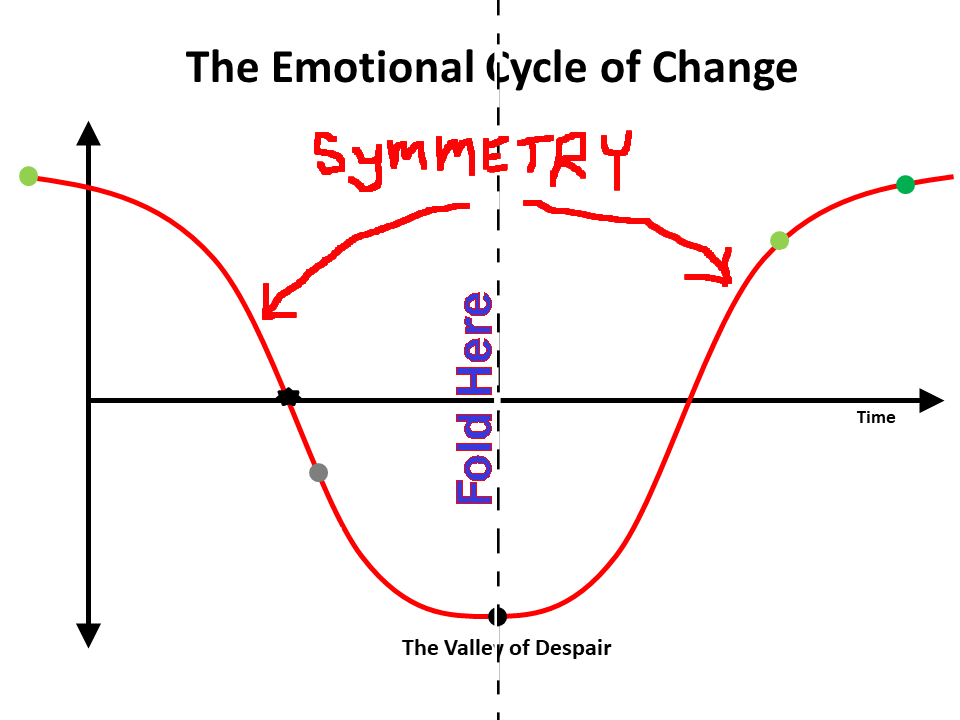
It’s often shown as a smooth curve—starting high, dipping down, then rising back up to success.
On paper, it looks clean. Predictable. Almost reassuring.
But there’s a problem with that picture.
Actually… there are two I will reveal after we look at the pattern.
The Emotional Cycle: Stage by Stage
Stage 1: Uninformed Optimism (The Excitement of New Beginnings)
This is where it always starts.
You’re excited. Motivated. Certain this time will be different.
You’ve found the “ride.”
The course. The program. The plan.
And it all makes sense.
You can see the path clearly.
“This is it.”
“This is the one.”
“This time I’m actually going to follow through.”
At this stage, you’re not stupid…
You’re uninformed.
You simply don’t know what you don’t know yet.
It’s like sitting on that rocket bike, looking down the ramp.
Everything ahead feels possible.
Because you haven’t hit the throttle yet.
Stage 2: Informed Pessimism (Reality Sets In)
Then you start.
And almost immediately… friction shows up.
Things take longer than expected.
Results don’t come as fast as promised.
The steps aren’t as clear as they seemed.
That smooth “ride” you signed up for?
Now it’s rattling.
You start noticing things you didn’t see at the beginning:
Gaps in the process.
Things you don’t understand.
Skills you don’t have yet.
Doubt starts creeping in.
“Did I pick the wrong thing?”
“Am I doing this right?”
“Why does this feel harder than it should?”
This is where most people slow down.
Some stop.
But they haven’t hit bottom yet.
Stage 3: The Valley of Despair (Where Most People Quit)
Eventually… you get there.
Progress stalls.
Or disappears completely.
The effort you’re putting in doesn’t seem to match the results you’re getting.
And that’s when it hits:
The Crisis of Meaning
“Why am I even doing this?”
This is the moment that breaks people.
Because now it’s not just hard…
Now it feels pointless.
You start questioning everything:
Was this the wrong path?
Was this the wrong “ride”?
Or… is something wrong with me?
And this is where things start to splinter.
Some people quit entirely.
Some people switch to a new “ride,” hoping the next one will fix the problem.
Some keep going… but without clarity, just grinding it out.
This is also where Shiny Object Syndrome takes over.
You see something new.
Something easier.
Something that promises faster results.
And for a moment…
You feel that spark again.
But if you’re not careful, you don’t escape the valley.
You just reset the cycle.
Back to the top.
👆 Back to Stage 1.
👉 Do not pass go. Do not collect $200.
And the loop continues.
Stage 4: Informed Optimism (A Shift in Perspective)
If you don’t quit… something starts to change.
Not all at once.
Not dramatically.
But enough to notice.
You begin to understand what’s actually required.
You start seeing where you were off.
Where the gaps really are.
What actually matters… and what doesn’t.
The work doesn’t necessarily get easier.
But you get better at it.
And that changes how it feels.
👉 This is Informed Optimism.
Not blind excitement like the beginning…
But earned confidence.
You’ve been through the valley.
You’ve felt the doubt.
And you’re still moving.
It’s like cresting the arc of that jump.
You can finally see the landing zone.
You’re not there yet…
But now you know it’s possible.
Stage 5: Success and Fulfillment (The Other Side)
Eventually… you land.
The results start to show.
The skills click into place.
The effort finally matches the outcome.
And what once felt impossible…
Now feels repeatable.
This is where most people think the story ends.
👉 But this is actually where the real insight begins.
The Insight Most People Miss
The Emotional Cycle of Change is often shown as a smooth, symmetrical curve.
A rise… a fall… and a climb back up.
But that picture hides the part that matters most.
The Valley Isn’t a Dip
The lowest point—the Valley of Despair—isn’t a quick drop and rebound.
It’s long.
It’s flat.
And it has no clearly defined end.
When you’re in it, it doesn’t feel like a phase.
It feels like you’re stuck.
Like nothing is working.
Like you’re putting in effort—but not getting anywhere.
Like maybe this whole thing was a mistake.
Some people stay there for days.
Some stay for months.
Some… never make it out—trapped, frustrated, wondering if all their effort has been for nothing.
The Symmetry Is a Lie
The typical diagram is symmetrical.
Which quietly tells your brain something dangerous:
“If it took this long to get here… it should take about the same time to get out.”
That’s almost never true.
Getting into the valley is fast.
Getting out… is slow. Uneven. Messy.
And when your experience doesn’t match that expectation, you start to think:
You start to think the problem is you.
“I must be doing something wrong.”
But you’re not.
👉 You’re just in the part no one prepared you for.
Why This Matters
If you don’t understand this cycle, the valley feels like failure.
So you quit.
Or you chase a new ‘ride,' hoping this one will finally work.
Or you reset everything and begin again from scratch.
Or you convince yourself this just isn’t for you.
But if you do understand it?
You recognize the moment for what it is:
Not failure…
But the exact point where most people turn back.
And that changes everything.
The Real Problem Isn’t the Work
It’s what you do in the valley.
This is where people start trying to “fix” everything.
They chase new strategies.
New tools.
New programs.
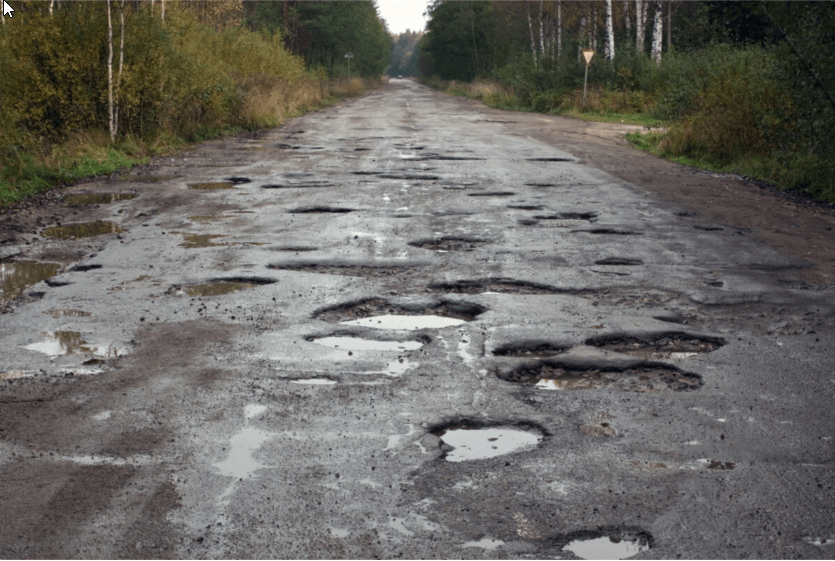
Trying to fill every pothole they hit.
And without guidance, they waste months—sometimes years—on efforts that don’t move the needle.
Most of those potholes don’t need to be filled—
They need to be avoided.
👉 But if you don’t know the difference, you stay stuck.
Why Some People Make It Through (and Most Don’t)
The people who make it through the valley aren’t necessarily smarter.
They don’t have more time.
They don’t have some hidden advantage.
They just have better guidance—someone who’s already been through it, who can say:
“Ignore that.”
“Focus on this.”
“You’re closer than you think.”
Without that guidance, most people wander in circles, losing months—or even years—without realizing they’re going nowhere.
That's the difference between:
Following a map…
And wandering through the desert hoping you’re going the right direction.
And That’s Where Mentorship Comes In
A mentor doesn’t remove the valley.
They help you navigate it safely.
They’ve already been through it.
They can see what you can’t.
They know which potholes matter…
And which ones don’t.
Because when you’re in the valley…
You’re too close to it to see it clearly.
Without guidance, you risk wasting months—or even years—on distractions that don’t move you forward.
Sometimes, having the right mentor is the difference between staying stuck—
And realizing you were closer than you thought.
Final Thought
The Emotional Cycle of Change isn’t something to avoid.
It’s something to understand.
Because once you recognize it…
You stop mistaking the hard part for failure.
You realize that the valley—
The frustration…
The doubt…
The feeling that nothing is working…
Isn’t the end of the road.
It’s the point where most people turn back and lose months, even years, of progress.
And if you can stay in it just a little longer—
With the right perspective and guidance—
You give yourself a real chance to reach the other side.
That Keto diet I plateaued on? I ended up reaching out to someone that was ahead of me, that had found success. They suggested adding in some exercise. I did that. I enjoyed - mountain biking. With that, I found my success too!
You’re probably closer than you think.
Next Steps
In the next post, I’ll break down what actually helps you move through that valley—without starting over every time things get hard.
👉 Read: The Slight Edge — Why Small Daily Disciplines Change Everything"
Mentor in the Middle
Helping experienced marketers who are stuck navigate online business using simple frameworks, real-world experience, and AI tools.
© 2026 Digital Marketers Mentor
Not affiliated with Facebook, TikTok, or Google. Results vary.
Newsletter
Get simple frameworks and insights to help you move forward—without starting over.
You’re probably closer than you think.