
Mentor in the Middle Blog
You're Doing the Work… So Why Isn't It Adding Up Yet?
TL; DR
Most people don't quit.
They do something more expensive — they ease up right before things compound.
Small consistent actions, taken past the point where relief sets in, are what separate the people who break through from the people who reset.
You don't need a dramatic change.
You need to stop releasing the accelerator.
You're showing up, posting, learning… but the results still feel random.
Introduction: The Pattern Nobody Names
There's a moment most people never see coming.
Not the crash. Not the obvious quit.
Something quieter.
You've been grinding. Something painful pushed you to move — a bill you couldn't ignore, a number in your account that scared you, a moment where the gap between where you are and where you want to be felt too wide to stand.
So you moved.
You worked harder. You added something. You found a way.
And it helped. The pressure eased. The immediate pain lifted.
And then — almost invisibly — you let off the accelerator. Just a little.
Not all at once. Not dramatically.
Just... a hair.
And that small release is what costs you everything.
My Hamster Wheels
I didn't understand this pattern for a long time.
Looking back now, I can see it running through almost every side hustle I ever chased:
Overtime at work when the bills stacked up
A paper route — right after I got married and had my daughter
Trying to build an online business in 1996, before half the automation we take for granted even existed
Storage unit auctions
Flipping a house
Each one started the same way. Pain. Movement. A little relief.
And each one ended the same way too.
Not with a dramatic failure. Not with a decision to quit.
Just with the pressure easing... and me quietly easing with it.
I've come to call this the two hamster wheels.
Hamster Wheel #1 is at the bottom of the valley — what I wrote about in the Emotional Cycle of Change.
You're frustrated.
Nothing seems to work.
So you start chasing — new tools, new strategies, new "rides" that promise to finally carry you across.
You're busy, you're spinning, but you're not actually moving forward.
You're just hitting potholes and trying to fill them all, without knowing which ones actually matter.
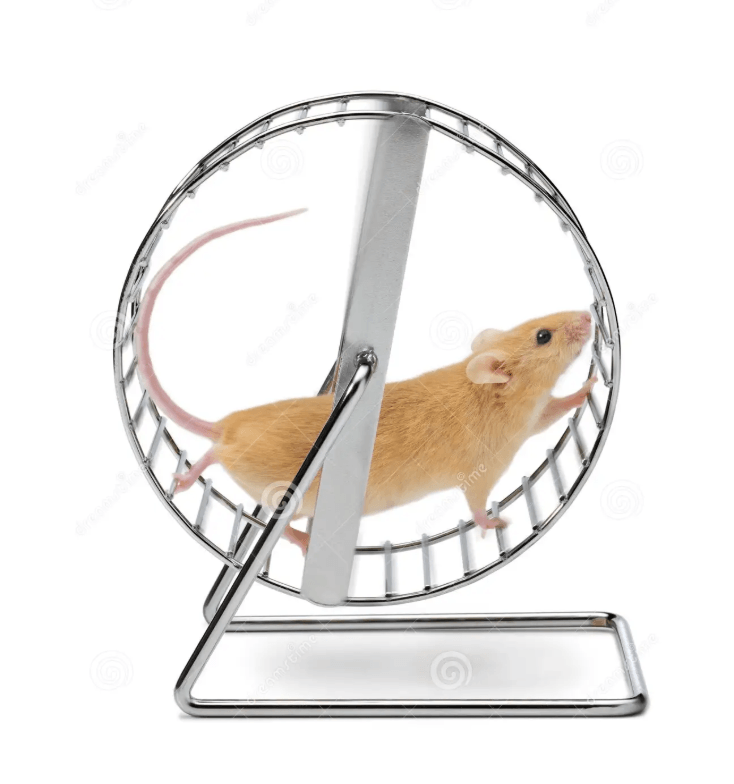
Hamster Wheel #2 is worse, because it's sneakier.
This one happens on the way up.
You've stopped spiraling.
You're making some progress.
Things are starting to work — just enough to ease the pain that got you moving in the first place.
And that's exactly when you quietly release the accelerator.
Not because you quit. Not because you gave up.
Because the immediate pressure is gone.
And without that pressure, the urgency fades. The energy softens. The consistent daily effort — the kind that was just starting to compound — slows down.
And slowly, almost without noticing, you drift back into the valley.
Until something painful enough makes you move again.
And the cycle resets.
The Moment I Heard It in My Own Voice
I couldn't see this pattern clearly until I heard someone else describe it back to me.
I was listening to Jeff Olson's The Slight Edge on Audible.
What struck me first was the narrator — he had this easy, slightly surfer-guy voice.
Unhurried.
Unguarded.
It didn't sound like a business book.
It sounded like someone talking to me the way I talk to myself.
And somewhere in that book, Olson describes exactly this pattern — the way people do enough to relieve the pain, then ease up, then drift back, then repeat.
The way the small daily disciplines that would change everything are so easy to do... and so easy not to do.
And how, because missing one day feels like nothing, we miss another. And another. Until we've quietly drifted back to where we started.
I heard that and thought: That's me.
Not a version of me. Not something I used to do.
That's me, right now, across every side hustle I'd ever tried.
I didn't need to do an inventory.
I didn't need to map it out.
I just recognized it — the way you recognize your own voice on a recording and feel slightly startled by it.
That recognition was the turning point.
Not because I suddenly had a system.
But because once you see the pattern, you can't unsee it.
And seeing it is what makes it possible to interrupt it.
What the Slight Edge Actually Is
The concept is simple.
Almost insultingly simple.
Small disciplines, repeated consistently over time, compound into results that look impossible from the outside.
That's it.
No secret tactic.
No dramatic breakthrough.
No perfect morning routine.
Just: show up, do the small thing, don't stop when the pain eases.
The reason it works is the same reason it's hard — the daily action is almost invisible in the moment.
Doing it today doesn't feel like it matters.
Skipping it today doesn't feel like it costs anything.
But compounding doesn't care about how it feels in the moment.
It cares about what you actually do, day after day, past the point where the pressure is gone.
This is where most people lose.
Not at the bottom of the valley — though that's hard too. But on the way up. When things start to work just enough to ease the pain that was driving them.
That's the moment the Slight Edge gets abandoned.
And that's the moment everything resets.
Where This Connects to Everything Else
Once I understood this, I started seeing it everywhere in the frameworks I'd already been using.
In the Value Equation — I wrote about how people quietly negotiate their dream down when the path feels too heavy.
The Slight Edge is what prevents that collapse. When you're making small, visible, consistent progress — even tiny progress — the brain gets the signal it needs to keep going.
👉 Evidence replaces hope. And the dream holds.
In Price's Law — a small fraction of effort drives the majority of results.
The Slight Edge is what moves you into that fraction.
Not by doing more.
👉 By doing the right things consistently, past the point where most people quietly stop.
In the Emotional Cycle — the Valley of Despair isn't just about doubt or discouragement.
It's about the hamster wheels.
Shiny Object Syndrome on the way down.
The relief-release trap on the way up.
👉 The Slight Edge is the rope through both.
And here's what I didn't expect:
Those side hustles I listed — the paper route, the house flip, the storage unit auctions, the online business attempt in 1996 — they weren't failures.
They were evidence that I never fully stopped.
Curiosity kept pulling me forward even when pain wasn't pushing me.
The Slight Edge was operating in the background the entire time.
👉 I just didn't have a name for it yet.
What This Actually Looks Like in Practice
This isn't about hustle. It's not about working harder.
It's about three things:
1. Don't let relief be the signal to stop.
When the immediate pain eases — that's exactly when most people quietly release the accelerator.
Recognize that moment.
Name it.
Keep going anyway.
2. Make the daily action small enough that stopping feels unreasonable.
The Slight Edge works because tiny consistent actions are easy to maintain — but also easy to skip.
Make yours so small that skipping feels like a deliberate choice, not a default.
One thing.
Every day.
Past the point where the pressure is gone.
3. Get feedback early and often.
One of the reasons people drift back is because they can't see the compound effect building.
Find ways to make progress visible — even in small ways.
A number that moves.
A skill that clicks.
A conversation that goes differently.
Early wins change the equation.
👉 They're the signal the brain needs to keep going.
You Don't Have to Wait for an Audiobook to Say It Back to You
That's what the mentor in the middle is for.
Someone who's already been through both hamster wheels. Who can see where you are in the cycle.
Who can tell you: you're not stuck — you just released the accelerator too soon.
Final Thought
You've probably already been on the Slight Edge without knowing it.
Every time you pushed through something hard.
Every side hustle that didn't fully work but taught you something.
Every time you moved even when the result wasn't there yet.
The pattern was already running.
You just needed to see it.
Now you have.
Don't ease up.
What Comes Next
If this resonated — the hamster wheels, the relief-release trap, the pattern you couldn't name until now — then you're ready for the next step.
I put together a short guide that goes deeper on the frameworks I use to stay on the Slight Edge when the pressure eases. It's free, and it's where I share the stuff that doesn't make it into the blog.
👉 Enter your name and email here to get started — you'll land on a page that shows you exactly what I've been using, including the community where I found my own momentum.
No fluff. No pitch-fest. Just the next logical step.
Mentor in the Middle
Helping experienced marketers who are stuck navigate online business using simple frameworks, real-world experience, and AI tools.
© 2026 Digital Marketers Mentor
Not affiliated with Facebook, TikTok, or Google. Results vary.
Newsletter
Get simple frameworks and insights to help you move forward—without starting over.
You’re probably closer than you think.